CBSE Class 9 Maths Self Study Plan Without Internet: 30-Day Practice Schedule
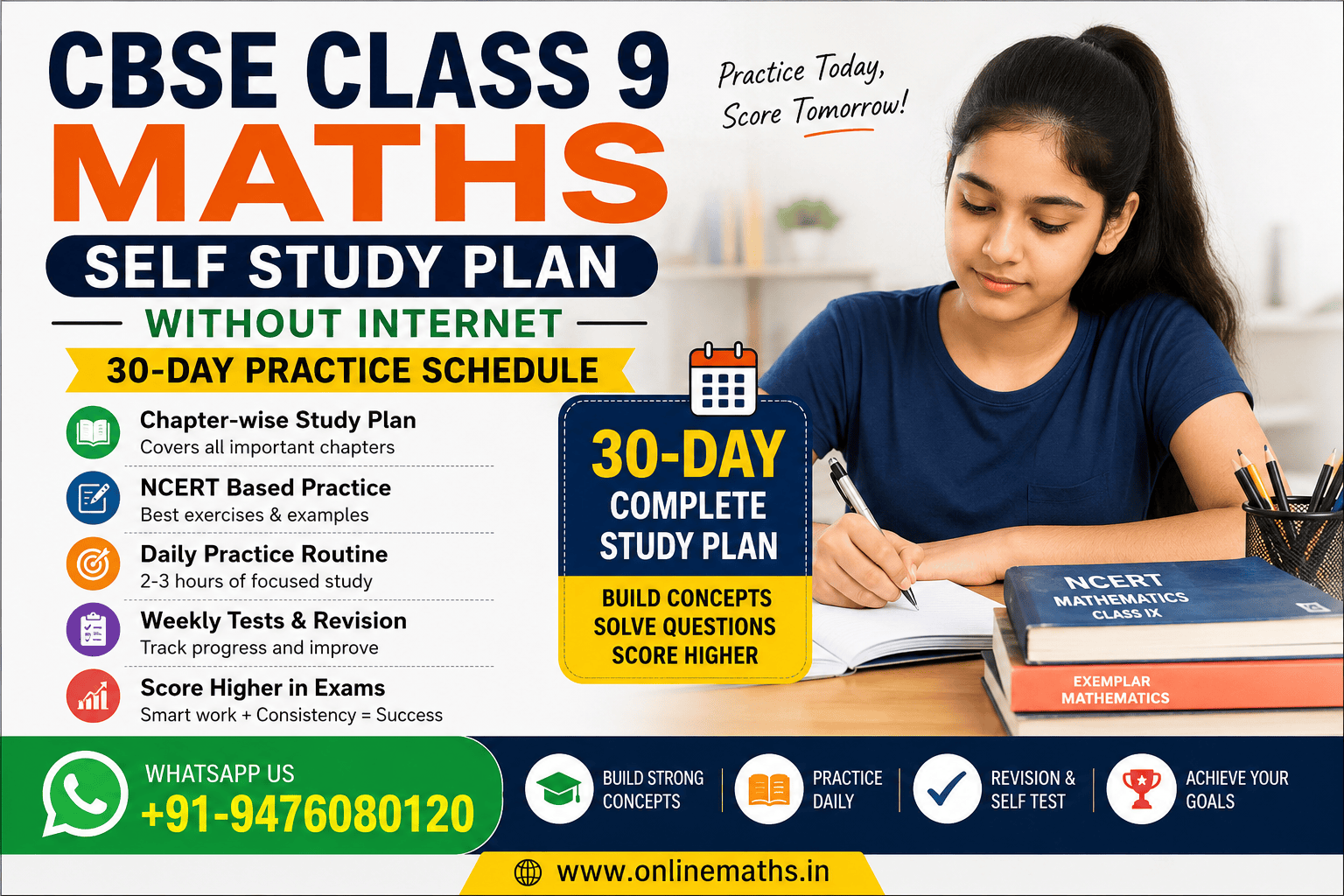
CBSE Class 9 Maths Self Study Plan Without Internet: 30-Day Practice Schedule
Preparing for CBSE Class 9 Maths does not always require an internet connection or expensive coaching. Many students achieve excellent results by following a well-planned offline study routine using NCERT textbooks, notebooks, and regular practice. If you have the right strategy, consistency, and discipline, you can build strong mathematical concepts and improve your problem-solving skills from the comfort of your home.
This 30-day CBSE Class 9 Maths self-study plan without internet is specially designed for students who want to improve their Maths performance through daily practice. Whether you are preparing for school exams, periodic tests, or your annual examination, this guide will help you stay focused and confident.
If you ever need expert guidance after your offline practice, you can also explore the live one-to-one Maths classes available at https://onlinemaths.in/.
Why Follow an Offline Self Study Plan for Class 9 Maths?
Studying without the internet offers several advantages. It helps students avoid distractions, develop concentration, and improve their ability to solve problems independently.
Benefits of Offline Maths Practice
- Better concentration without mobile distractions
- Strong understanding of mathematical concepts
- Improved calculation speed
- Better handwriting and presentation
- Increased confidence before examinations
- Healthy study habits
Students who regularly solve questions on paper generally perform better than those who only watch videos without practicing.
Study Materials Required
Before starting your 30-day plan, arrange these offline resources.
Essential Study Resources
- NCERT Class 9 Maths Textbook
- NCERT Exemplar Maths Book
- School notebook
- Formula notebook
- Graph notebook
- Geometry Box
- Scientific Calculator (only if permitted for practice purposes)
- Previous year school question papers
These books are enough to complete a strong CBSE Class 9 Maths self study plan.
Daily Study Routine
Consistency matters more than studying for long hours.
Suggested Daily Schedule
Morning (45 Minutes)
- Revise previous concepts
- Learn one new topic
- Write important formulas
Afternoon (60 Minutes)
- Solve NCERT examples
- Complete exercise questions
Evening (45 Minutes)
- Revise mistakes
- Practice additional questions
Total Study Time:
2–3 Hours Daily
30-Day CBSE Class 9 Maths Practice Schedule
Week 1: Build Strong Fundamentals
The first week focuses on understanding basic concepts.
Day 1
Chapter: Number Systems
- Learn Rational Numbers
- Learn Irrational Numbers
- Solve NCERT Examples
Day 2
Continue Number Systems
Practice:
- Exercise Questions
- Word Problems
- Revision
Day 3
Chapter: Polynomials
Topics
- Introduction
- Degree
- Terms
- Types of Polynomials
Day 4
Continue Polynomials
Practice all NCERT exercises carefully.
Day 5
Chapter: Coordinate Geometry
Topics
- Cartesian Plane
- Coordinates
- Plotting Points
Day 6
Revision
Solve mixed questions from
- Number Systems
- Polynomials
- Coordinate Geometry
Day 7
Weekly Test
Attempt one full offline test without looking at the solutions.
Week 2: Improve Conceptual Understanding
During the second week, focus on algebra and geometry.
Day 8–9
Linear Equations in Two Variables
Practice
- Graphical Representation
- Word Problems
- NCERT Exercises
Day 10–11
Introduction to Euclid's Geometry
Learn
- Definitions
- Axioms
- Postulates
Day 12
Lines and Angles
Practice
- Complementary Angles
- Supplementary Angles
- Vertically Opposite Angles
Day 13
Triangles
Learn
- Congruence
- Angle Properties
- Exterior Angle Theorem
Day 14
Weekly Revision Test
Solve 30–40 mixed questions.
Week 3: Practice More Questions
This week is all about improving speed and accuracy.
Day 15–16
Quadrilaterals
Topics
- Properties
- Angle Sum
- Midpoint Theorem
Day 17
Areas of Parallelograms and Triangles
Practice diagrams carefully.
Day 18
Circles
Topics
- Chords
- Angles
- Arcs
Day 19
Construction
Draw neat diagrams using your geometry box.
Day 20
Heron's Formula
Solve numerical problems.
Day 21
Weekly Mock Test
Attempt a complete offline paper.
Week 4: Final Revision
The last week is dedicated to revision and confidence building.
Day 22
Surface Areas and Volumes
Practice all formula-based questions.
Day 23
Statistics
Learn
- Frequency Distribution
- Mean
- Data Interpretation
Day 24
Probability
Practice simple probability questions.
Day 25
Revise Algebra Chapters
- Number Systems
- Polynomials
- Linear Equations
Day 26
Revise Geometry Chapters
- Triangles
- Circles
- Quadrilaterals
Day 27
Revise Mensuration
Solve mixed numerical questions.
Day 28
Formula Revision
Prepare one-page notes for every chapter.
Day 29
Attempt One Full-Length Sample Paper
Solve within the official exam time.
Day 30
Final Self Assessment
Check
- Weak Chapters
- Calculation Mistakes
- Formula Errors
Reward yourself after completing the 30-day plan.
How to Revise Class 9 Maths Effectively
Revision plays an important role in long-term learning.
Best Revision Tips
Revise Every Formula
Maintain a separate formula notebook.
Solve Previous Mistakes
Never repeat the same mistake twice.
Practice Daily
Even 20 questions every day can improve your confidence.
Write Every Solution
Avoid solving Maths mentally.
Common Mistakes Students Should Avoid
Many students lose marks because of simple mistakes.
Do Not
- Skip NCERT examples
- Memorize without understanding
- Ignore diagrams
- Leave difficult chapters
- Study only before exams
- Avoid revision
Regular practice is the key to success.
How Parents Can Help
Parents can make offline learning more productive.
Suggestions
- Create a fixed study schedule.
- Reduce distractions during study time.
- Conduct weekly tests.
- Encourage children to solve problems independently.
- Appreciate consistent effort.
When Should You Join Online Maths Coaching?
Although offline self-study is highly effective, some students need expert guidance to understand difficult concepts.
If you find chapters such as Triangles, Heron's Formula, Surface Areas and Volumes, or Linear Equations challenging, consider taking personalized guidance from experienced Maths teachers.
At OnlineMaths.in, students receive:
- Live One-to-One Maths Classes
- Experienced CBSE Maths Tutors
- Personalized Learning Plans
- Doubt Solving Sessions
- Flexible Class Timings
- Chapter-wise Revision
- Regular Mock Tests
- Free Demo Class
Suggested Internal Links for Onlinemaths.in:
Conclusion
A well-structured CBSE Class 9 Maths Self Study Plan Without Internet can help students build strong concepts, improve calculation skills, and perform better in examinations. The key is consistency, daily practice, and regular revision using trusted resources like the NCERT textbook.
Remember, success in Maths is not about studying for long hours—it is about practicing the right questions every day. Follow this 30-day practice schedule, stay disciplined, and track your progress each week. If you need additional support, personalized guidance, or doubt-solving sessions, Onlinemaths.in offers live one-to-one CBSE Maths classes designed to help students achieve their academic goals. Start your preparation today, stay committed to your study plan, and build a strong foundation for future success.