CBSE Class 10 Maths High-Weightage Chapters 2027
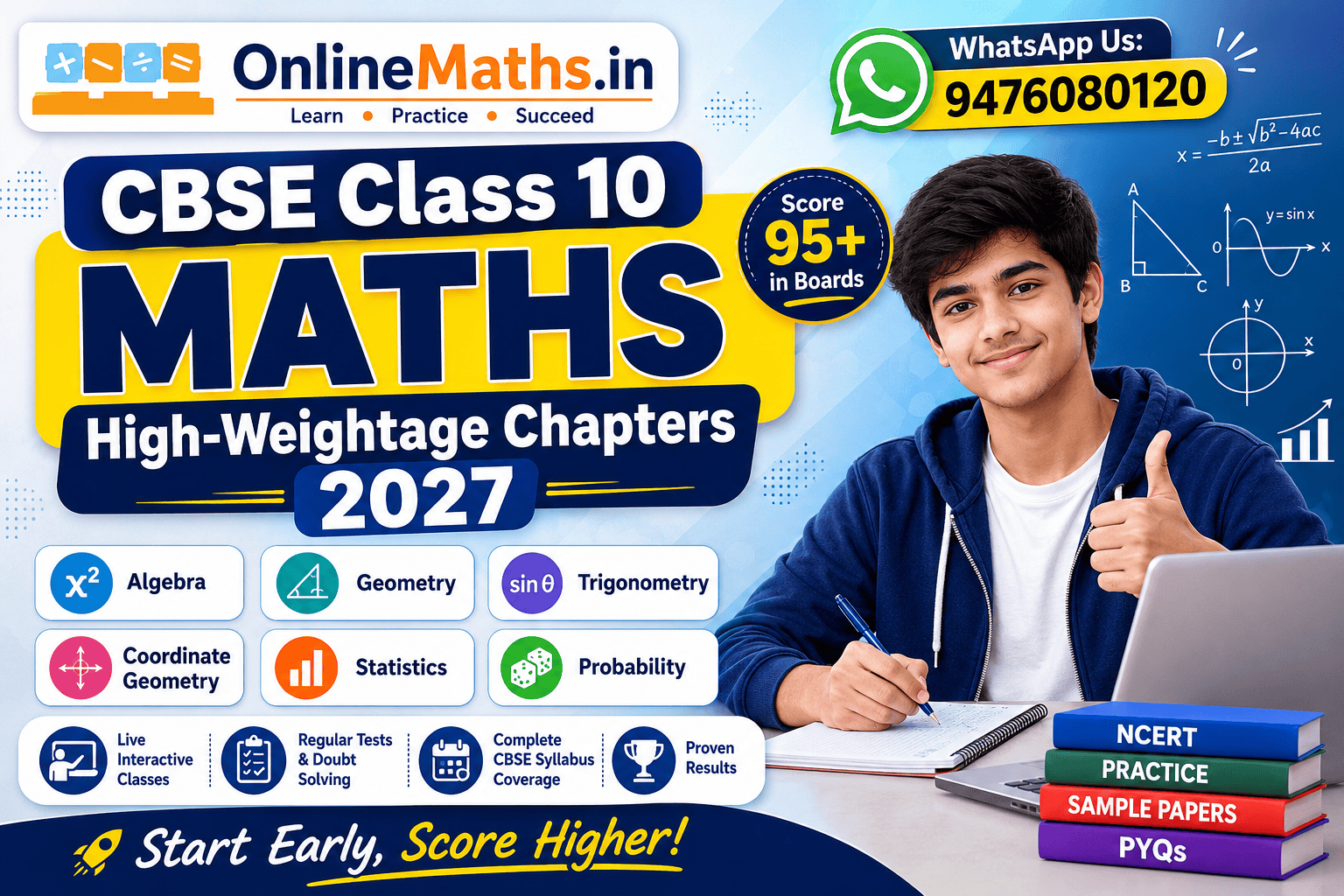
CBSE Class 10 Maths High-Weightage Chapters 2027: Chapter-Wise Preparation Guide
Preparing for the CBSE Class 10 Maths Board Exam 2027 becomes much easier when students understand which units deserve more attention and how to divide their study time. However, students should not completely ignore any chapter just because it appears less important.
For the 2026–27 session, CBSE continues to emphasize conceptual understanding, mathematical reasoning, application-based learning, and competency-focused assessment. CBSE's official learning framework also highlights different question types and assessment objectives rather than relying only on direct formula-based questions.
This guide explains the CBSE Class 10 Maths high-weightage chapters for 2027, the important topics within them, and a practical strategy for scoring well.
If you are looking for structured support, you can also explore CBSE Maths Online Classes at Online Maths** for guided preparation and regular practice.**
Why Should You Focus on High-Weightage Chapters?
The CBSE Maths syllabus contains several chapters covering algebra, geometry, trigonometry, statistics, probability and other mathematical concepts. Spending equal time on every topic may not always be the most efficient strategy, particularly when board examinations are approaching.
A better approach is to:
- Complete the entire syllabus.
- Identify chapters that contribute significantly to the overall paper.
- Strengthen concepts before memorising formulas.
- Practise NCERT questions thoroughly.
- Solve competency-based and application-based questions.
- Attempt sample papers and previous examination questions.
- Keep sufficient time for revision.
Important: CBSE does not guarantee a fixed chapter-wise number of marks for every individual chapter. Therefore, students should treat "high-weightage chapters" as preparation priorities rather than assuming that a particular chapter will definitely carry a specific number of marks.
CBSE Class 10 Maths High-Weightage Chapters 2027
For effective preparation, students should give special attention to the following major areas:
1. Algebra
Algebra is one of the most important sections of Class 10 Mathematics. Students should develop strong problem-solving skills because algebraic concepts often require multiple steps.
Important topics include:
- Polynomials
- Pair of Linear Equations in Two Variables
- Quadratic Equations
- Arithmetic Progressions
Important Preparation Tips
Understand the difference between different types of equations and learn when to use particular methods.
For example, while solving pair of linear equations, practise:
- Graphical method
- Substitution method
- Elimination method
- Word problems
For quadratic equations, students should be comfortable with factorisation and the quadratic formula wherever applicable.
How to Prepare Algebra
Start with NCERT examples and exercises. After completing them, move to mixed questions that require students to identify the appropriate method before solving.
Students preparing from home can also use online CBSE Maths tuition for additional explanation and practice.
2. Geometry
Geometry is another important part of Class 10 Mathematics. It requires students to understand theorems and apply them logically rather than simply memorising statements.
Important areas include:
- Triangles
- Circles
- Similarity
- Tangent-related concepts
- Theorems and their applications
How to Score Better in Geometry
The best way to prepare geometry is to understand why a theorem works and how it can be applied to different figures.
Students should practise:
- Drawing accurate diagrams.
- Writing given information clearly.
- Identifying the relevant theorem.
- Showing each step logically.
- Writing the final conclusion clearly.
Common Mistake
Many students remember a theorem but cannot recognise when it should be applied. Regular practice with different diagrams can solve this problem.
3. Trigonometry
Trigonometry can become a high-scoring section when students understand the relationships between trigonometric ratios and practise application-based questions.
Important topics include:
- Trigonometric ratios
- Values of standard angles
- Trigonometric identities
- Heights and distances
Trigonometry Preparation Strategy
First, memorise the standard values and understand the basic ratios. Then practise identities and application-based problems.
Students should maintain a small trigonometry formula sheet containing important identities and standard values.
Practice Tip
Do not solve only questions that look similar to textbook examples. Include questions where you need to decide which identity or ratio should be used.
4. Statistics and Probability
Statistics and Probability are important because many students find these topics relatively systematic once the formulas and procedures are understood.
Important areas include:
- Mean
- Median
- Mode
- Grouped data
- Probability
How to Prepare Statistics
Students should practise every step carefully. A small calculation error can affect the final answer.
Create a separate formula sheet for:
- Mean
- Median
- Mode
- Probability
Then solve mixed questions without looking at the formulas.
How to Improve Accuracy
After completing a statistics question, check:
- Whether the correct values were substituted.
- Whether calculations are accurate.
- Whether the final answer is presented correctly.
- Whether the required unit or interpretation is included.
5. Coordinate Geometry
Coordinate Geometry combines algebraic calculations with geometric concepts. It is generally easier to score in when students are comfortable with formulas and substitution.
Students should practise:
- Distance-related concepts
- Section-related calculations
- Area-related questions
- Coordinate-based application problems
Best Way to Study Coordinate Geometry
Instead of memorising formulas without understanding them, learn what each formula represents.
After learning a formula, solve at least 5–10 questions of different difficulty levels.
Students should also practise questions where coordinates are presented in different orders or involve negative values.
Which Chapters Should You Study First?
A practical order for preparation can be:
Phase 1: Build Your Foundation
Start with:
- Algebra
- Coordinate Geometry
- Trigonometry
These topics require regular practice, so beginning them early can give students more time to improve.
Phase 2: Strengthen Geometry
Next, focus on:
- Triangles
- Circles
- Other geometry concepts included in the prescribed syllabus
Spend time understanding theorem-based questions rather than simply memorising solutions.
Phase 3: Complete Statistics and Probability
Once the major algebra and geometry topics are under control, revise statistics and probability systematically.
CBSE Class 10 Maths 2027 Preparation Strategy
High-weightage topics alone cannot guarantee a high score. Your preparation method matters equally.
1. Complete NCERT First
NCERT should form the foundation of your preparation. Work through:
- Examples
- Exercises
- Important formulas
- Theorems
- Application questions
Do not immediately move to multiple reference books before completing the prescribed textbook work.
2. Create a Chapter-Wise Formula Notebook
Keep one small notebook specifically for mathematics formulas.
Divide it into sections such as:
Algebra
Write important identities and formulas.
Geometry
Write important theorems and results.
Trigonometry
Write ratios, identities and standard values.
Statistics
Write the required formulas and procedures.
Review this notebook regularly rather than only before the examination.
3. Practise Competency-Based Questions
CBSE's learning framework includes assessment of skills such as applying mathematical concepts and solving problems in different contexts.
Therefore, students should practise questions that ask them to:
- Analyse information.
- Select an appropriate method.
- Interpret a situation.
- Apply formulas.
- Explain mathematical reasoning.
This is especially useful for students who are accustomed only to direct textbook questions.
4. Solve Sample Papers
Once you have completed the syllabus, begin solving full-length papers.
Try to simulate examination conditions:
Step 1: Set a timer.
Step 2: Keep your books away.
Step 3: Attempt the complete paper.
Step 4: Check your answers.
Step 5: Record every mistake.
CBSE provides sample papers and other academic resources through its official academic portal, so students should always verify the latest examination-related material from official sources.
How Can Online Maths Coaching Help?
Some students understand mathematics quickly in school, while others need additional explanation and individual attention.
Online coaching can be useful when a student:
- Finds particular chapters difficult.
- Needs help with homework.
- Wants regular tests.
- Requires concept-based explanations.
- Struggles to maintain a study schedule.
- Wants additional board-exam practice.
At Online Maths, students can explore online mathematics learning options designed around CBSE preparation.
You can also learn more through the CBSE Class 10 Maths Online Tuition section of the website.
90-Day Strategy for CBSE Class 10 Maths 2027
If you have approximately three months before the examination, divide your preparation into three stages.
Days 1–30: Complete Concepts
Focus on understanding the syllabus and completing NCERT.
Do not worry about speed during this stage.
Goal:
Concept clarity + NCERT completion
Days 31–60: Intensive Practice
Start solving:
- Important questions
- Competency-based questions
- Mixed exercises
- Application-based problems
- Previous examination questions
Goal:
Accuracy + problem-solving ability
Days 61–90: Revision and Mock Tests
During the final stage, concentrate on:
- Formula revision
- Theorem revision
- Weak chapters
- Full-length sample papers
- Time management
- Mistake correction
Goal:
Speed + accuracy + confidence
Common Mistakes Students Should Avoid
Studying Only High-Weightage Chapters
High-weightage chapters deserve additional attention, but ignoring other chapters can cost valuable marks.
Memorising Without Understanding
Mathematics requires application. Memorised steps may not work when a question is presented differently.
Avoiding Difficult Questions
If a topic feels difficult, do not permanently skip it. Break it into smaller concepts and practise gradually.
Not Checking Mistakes
Simply solving hundreds of questions is less useful if you repeatedly make the same mistakes.
Maintain a mistake notebook and review it every week.
Final Thoughts
The CBSE Class 10 Maths Board Exam 2027 should be approached with a combination of complete syllabus coverage, focused revision and consistent practice. Algebra, Geometry, Trigonometry, Statistics, Probability and Coordinate Geometry deserve careful preparation, but students should remember that CBSE does not guarantee a fixed chapter-wise mark distribution.
The best strategy is to complete NCERT thoroughly, strengthen important concepts, practise competency-based questions, solve sample papers and regularly revise your mistakes.
If you need structured guidance, Online Maths can be a useful resource for students looking for online CBSE Maths learning and additional practice.
Start early, practise consistently, and focus on understanding mathematics—not just memorising answers.