AI vs Human Maths Tutor: Which Is Better for CBSE Students in 2026?
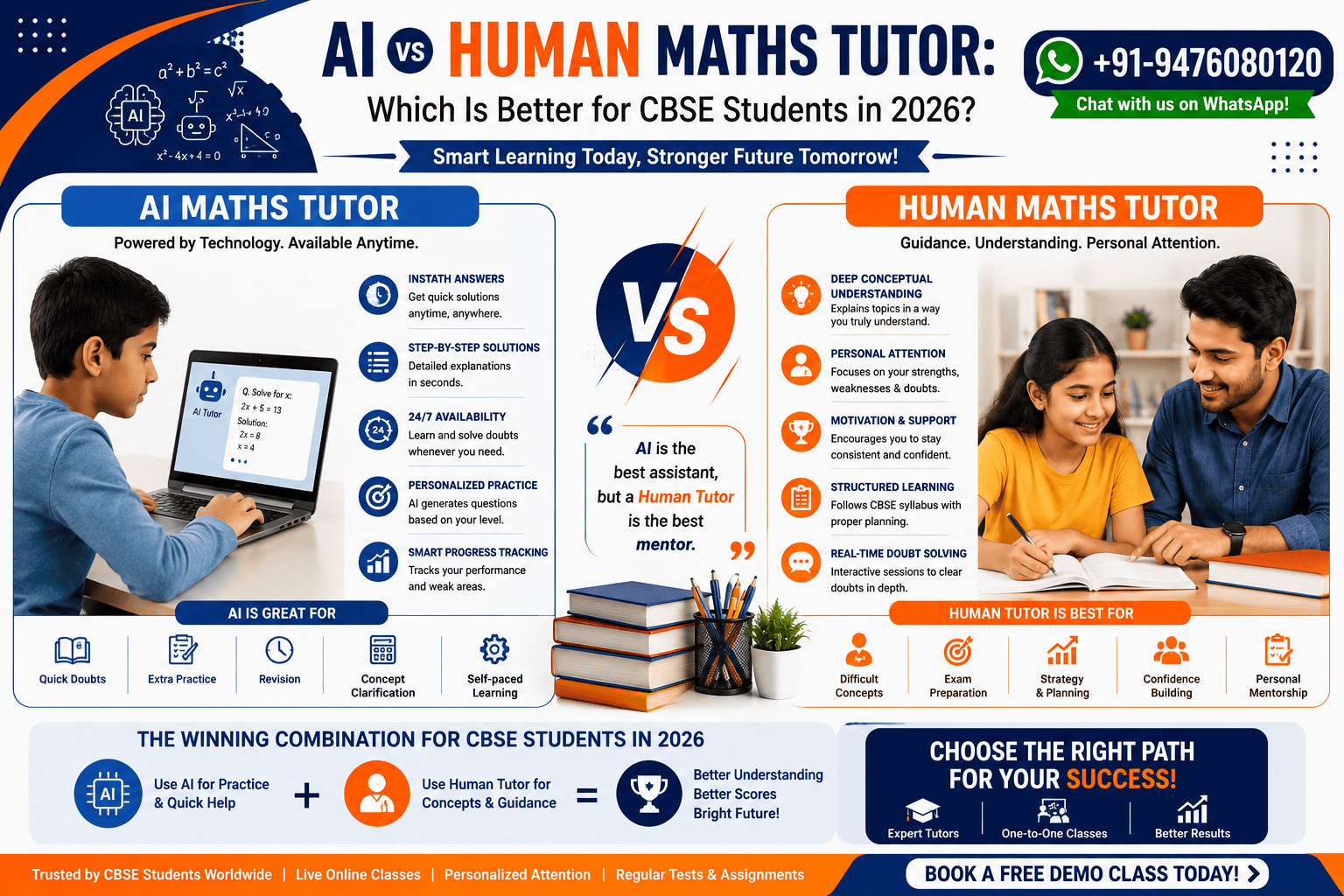
AI vs Human Maths Tutor: Which Is Better for CBSE Students in 2026?
Artificial Intelligence is changing the way students learn. In 2026, CBSE students have access to AI-powered learning tools that can explain mathematical problems, generate practice questions, provide instant feedback, and help with revision. At the same time, human teachers continue to play an important role in explaining concepts, understanding student difficulties, and providing personalized academic guidance.
This raises an important question for parents and students: AI vs Human Maths Tutor—which is better for CBSE students in 2026?
The answer is not necessarily one or the other. AI can be a useful learning assistant, while an experienced human teacher can provide structured teaching, motivation, personal attention, and deeper understanding. For many students, combining technology with online maths coaching can provide a more balanced learning experience.
What Is an AI Maths Tutor?
An AI Maths tutor is a digital learning system that uses artificial intelligence to respond to students' questions and provide explanations or practice activities.
Students can use AI tools to:
-
Ask questions about mathematical concepts
-
Get step-by-step explanations
-
Practice different types of questions
-
Generate additional exercises
-
Review mistakes
-
Revise topics whenever required
-
Get help outside regular study hours
AI can therefore be useful for independent practice and quick revision. Recent education discussions also show that students are increasingly using AI tools for concept clarification and Maths revision.
However, students should remember that an AI-generated answer should not automatically be treated as correct. AI systems can sometimes misunderstand a question or provide an explanation that does not match the student's exact learning requirement.
What Does a Human Maths Tutor Offer?
A human Maths tutor brings something different to the learning process: direct observation of the student.
An experienced teacher can notice whether a student is confused, rushing through calculations, memorizing formulas without understanding them, or repeatedly making the same type of mistake.
Personalized Teaching
A human teacher can change the explanation according to the student's response.
For example, if a student does not understand quadratic equations through an algebraic explanation, the teacher can use another example, draw a diagram, simplify the question, or connect it with a concept the student already understands.
Motivation and Accountability
Students sometimes know what they need to study but struggle to maintain a consistent routine.
A teacher can provide:
-
Regular homework
-
Practice assignments
-
Tests
-
Revision schedules
-
Performance feedback
-
Encouragement
-
Academic accountability
This makes online maths tuition different from simply asking an AI tool questions whenever a student gets stuck.
AI vs Human Maths Tutor: A Detailed Comparison
Let's compare both approaches based on the factors that matter most to CBSE students.
1. Concept Explanation
AI Tutor
AI can explain a mathematical concept quickly and can provide multiple explanations if the student asks follow-up questions.
It can be especially useful when a student wants a quick explanation while doing homework.
Human Tutor
A human teacher can observe the student's understanding and change the teaching method accordingly.
For students who struggle with fundamental concepts, personalized explanation can be particularly valuable.
Winner: Human tutor for deeper personalized learning.
2. Instant Doubt Solving
AI Tutor
AI has an advantage when it comes to availability. Students can ask questions whenever they need help, including outside regular class hours.
Human Tutor
A live tutor may not be available every minute of the day, but during a scheduled lesson the student can discuss the question directly and explain exactly where they are confused.
Winner: AI for instant availability; human tutor for interactive discussion.
3. Personalized Learning
AI Tutor
Some AI systems can adapt explanations and generate questions according to a student's responses.
Human Tutor
A teacher can consider the student's overall academic performance, classroom behavior, confidence, recurring mistakes, school schedule, and examination requirements.
Research published in 2026 on hybrid human-AI tutoring found evidence that combining AI support with differentiated human tutoring can improve learning outcomes compared with AI-only tutoring.
Winner: Human tutor, especially when supported by useful technology.
4. Regular Practice
AI Tutor
AI can generate additional questions quickly, which makes it useful for practice.
Students can request questions based on a particular chapter or difficulty level.
Human Tutor
A teacher can select questions based on the student's actual weaknesses and monitor how the student solves them.
Winner: Combination of AI and human guidance.
5. Exam Preparation
For CBSE students, exam preparation requires more than getting correct answers.
Students need to understand concepts, practice different question types, revise systematically, manage time, and learn from mistakes.
Human Teacher Advantage
A teacher can create a structured preparation plan and monitor progress.
AI Advantage
AI can provide additional practice and quick explanations during revision.
Therefore, online maths classes supported by technology can provide a useful combination of structured teaching and independent practice.
Why Online Maths Coaching Still Matters in the AI Era
The growth of AI does not mean that human teachers are becoming unnecessary.
In fact, CBSE itself is placing increasing emphasis on computational thinking and responsible understanding of AI. Its 2026–27 training theme is Computational Thinking and Understanding AI, with objectives including logical problem-solving, pattern recognition, interdisciplinary learning, and responsible AI use.
This means students increasingly need both technological awareness and strong foundational learning.
A good online maths coaching program can provide the human side of learning while students use technology as an additional practice tool.
Benefits of Online Maths Classes With a Human Teacher
Live Interaction
Students can communicate directly with their teacher during a lesson.
One-to-One Attention
A teacher can focus on the student's individual learning requirements.
Structured Syllabus Coverage
Lessons follow an organized sequence instead of students randomly jumping between topics.
Regular Tests
Teachers can conduct assessments and identify areas where students need additional practice.
Doubt Solving
Students can discuss difficult questions directly with their tutor.
Progress Monitoring
Teachers can track whether the student is actually improving rather than simply completing questions.
How AI Can Be Used Alongside Online Maths Tuition
AI does not have to compete with a human tutor. It can be used as a supporting learning tool.
Before the Class
Students can use technology to revise basic definitions or identify questions they did not understand.
During the Class
Students should focus primarily on the teacher's explanation and actively participate in solving problems.
After the Class
AI can be useful for generating additional practice questions or revising a concept already taught by the teacher.
Important Rule for Students
AI should be used as a learning assistant, not simply as an answer generator.
If students copy answers without understanding the method, they may complete homework but fail to develop independent problem-solving skills.
AI vs Human Maths Tutor for Different CBSE Classes
Class 6 to 8
Younger students often benefit strongly from human guidance because they are developing their fundamental mathematical habits.
Parents can explore CBSE Class 8 Maths Online Tuition for structured support.
Class 9
Class 9 introduces more advanced concepts and prepares students for Class 10.
Students can explore CBSE Class 9 Maths Online Tuition for personalized learning.
Class 10
For Class 10 students, consistent revision and examination preparation become particularly important.
Our CBSE Class 10 Maths Online Tuition program can provide structured support through live classes, practice, and doubt solving.
Class 11 and 12
Senior-secondary Maths requires deeper conceptual understanding and regular problem solving. Students can explore the OnlineMaths homepage to find suitable Maths programs for higher classes.
Which Is Better: AI or Human Maths Tutor?
There is no single answer for every student.
AI May Be Better For:
-
Quick questions
-
Instant explanations
-
Extra practice
-
Revision
-
Self-paced learning
-
Generating practice questions
Human Tutors May Be Better For:
-
Building strong foundations
-
Personalized teaching
-
Identifying learning gaps
-
Long-term academic planning
-
Motivation
-
Exam strategy
-
Regular monitoring
-
Complex doubts requiring discussion
The Best Approach
For many CBSE students, the most effective approach may be human-led learning supported by AI tools.
A human teacher provides direction, while technology can provide additional practice and accessibility.
How OnlineMaths Combines Technology With Human Learning
OnlineMaths focuses on teacher-led online maths classes designed around the student's learning requirements.
Students can benefit from:
-
Live interactive teaching
-
Personalized attention
-
One-to-one Maths coaching
-
Regular practice
-
Assignments
-
Doubt solving
-
Tests and assessments
-
Structured syllabus coverage
This approach ensures that students are not simply receiving answers—they are learning how to approach mathematical problems independently.
Tips for Parents Choosing Maths Coaching in 2026
Check the Teaching Method
Parents should understand whether the program focuses on conceptual learning or simply completing chapters.
Look for Personal Attention
A student who struggles with Maths may benefit from individualized guidance.
Ask About Tests
Regular assessment can help identify whether the student is actually progressing.
Consider AI as an Additional Tool
AI can be useful for revision and practice, but it should complement—not automatically replace—teacher guidance.
Focus on Long-Term Learning
The goal should not only be completing homework. Students should develop reasoning, accuracy, confidence, and independent problem-solving skills.